Vitalik Overturns the L2 Playbook! Why Is Ethereum’s Mainnet Returning to the Front Lines?

GM,
Crypto prices haven’t been performing well lately—it’s once again a test of faith. But even if what you believe in is the technology itself, you can still run into hard truths.
Just before the Lunar New Year, Vitalik Buterin, founder of Ethereum, dropped a bombshell. He stated that the Layer 2–centric scaling roadmap of the past five years is now “outdated.” Coupled with expectations that Ethereum’s mainnet (L1) performance will significantly improve this year, he proposed adjusting the development focus. Vitalik even said bluntly that Layer 2 solutions must find unique value beyond “scaling,” because in the future, Ethereum mainnet transaction fees alone may already be low enough.
These remarks, however, put L2 projects in an awkward position and quickly triggered community backlash. The founder of Arbitrum publicly distanced the project from Ethereum, stating, “Arbitrum is not Ethereum.” Meanwhile, Polygon, which had previously worked hard to be recognized as an L2, responded with humor: “In light of market trends, starting today we will refer to ourselves as a sidechain.” Camila Russo, author of The Infinite Machine, commented: “This is the end of an era.”
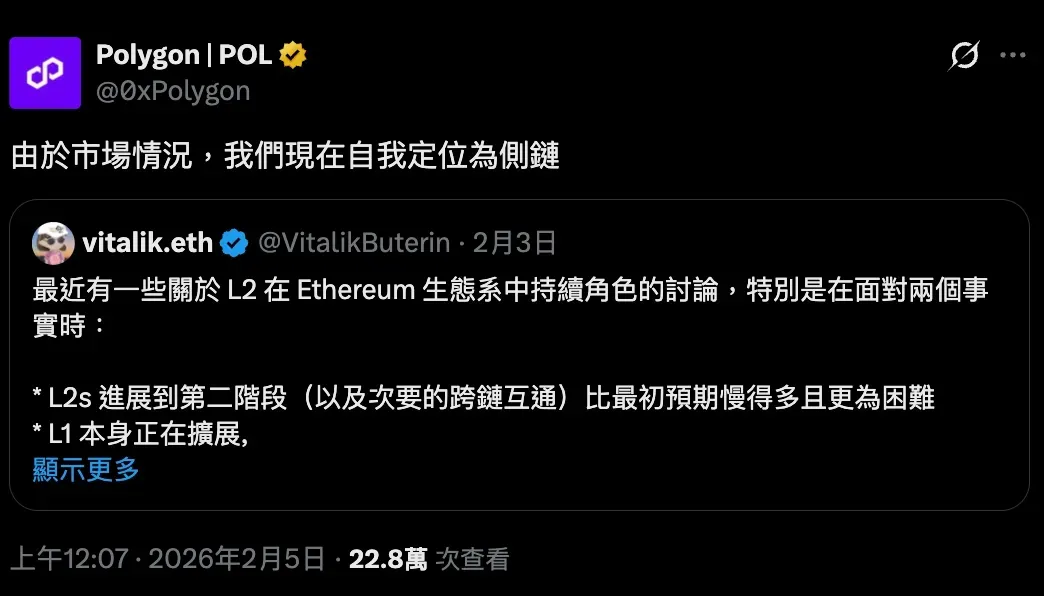
If I were an L2 developer, I probably wouldn’t be laughing either. But for users, this is good news. To understand why Vitalik Buterin suddenly made such a sharp turn, we need to revisit why Layer 2 existed in the first place.
Three Roadmaps
According to Vitalik’s post:
Let’s revisit the original vision: Ethereum needed to scale. But “scaling” meant creating a large amount of blockspace secured by Ethereum. In other words, as long as Ethereum’s mainnet operates normally, everything you do within that blockspace is guaranteed to be valid, censorship-resistant, and irreversible. By contrast, if you build an EVM chain capable of processing 10,000 transactions per second, but its connection to Ethereum is maintained through a multisig bridge, that does not count as scaling Ethereum.
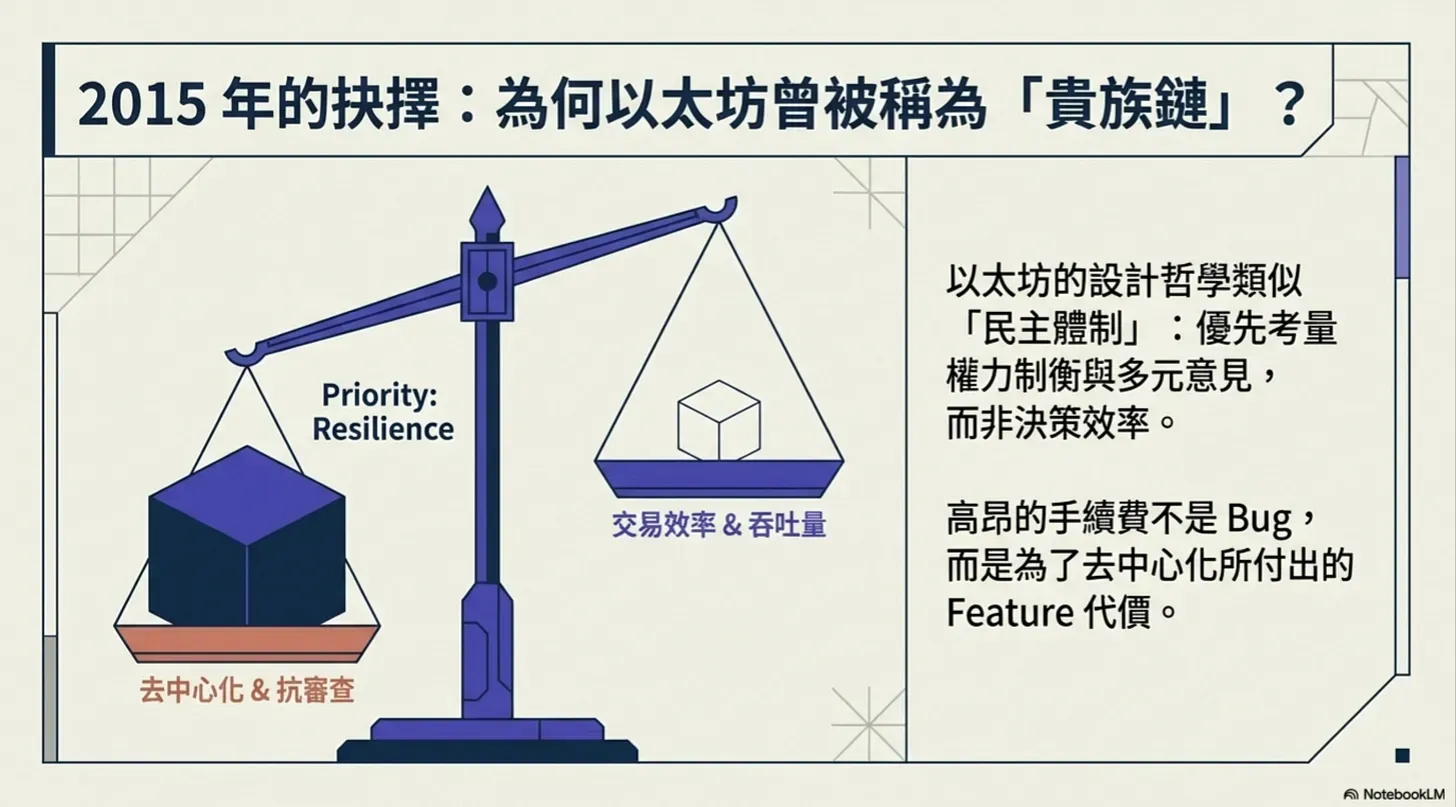
This passage provides background context, and it’s written quite concisely. Let me add some explanation. Years ago, Ethereum was mocked as the “chain for the aristocrats.” Whenever the market heated up, on-chain transaction fees would skyrocket, leaving only the wealthy able to afford using it. What many people didn’t realize, however, is that this wasn’t a bug—it was a feature.
When Ethereum was launched in 2015, it prioritized system resilience over efficiency from day one. Censorship resistance, immutability, and decentralization came first; transaction throughput came later. It’s similar to Taiwan’s choice of a democratic system—placing pluralism and checks and balances above sheer decision-making efficiency.
But the reality is: democracy doesn’t put food on the table. When on-chain fees remain persistently high, most people simply can’t afford to use the network. As early as 2017, developers began searching for ways to balance efficiency and decentralization. It was then that Vitalik Buterin proposed the blockchain “trilemma,” sharply identifying the core tension: security, decentralization, and scalability are difficult to achieve simultaneously.
Over time, three scaling roadmaps emerged:
- Upgrade hardware performance
- Advance sharding technology
- Move users to Layer 2 networks
The first path was the most intuitive, but it would sacrifice decentralization. The second was theoretically sound, yet technically formidable. In the end, Ethereum chose the third path—outsourcing the relatively secondary goal of “efficiency” to L2s, while allowing the mainnet to focus on security and decentralization.
In recent years, third-party Ethereum L2s have sprung up like mushrooms after the rain. Arbitrum, Base, and Polygonrose rapidly, and major exchanges gradually integrated support for them. At the time, Vitalik envisioned each L2 as an extension of Ethereum’s culture. Though independently developed, they would ultimately remain part of the broader Ethereum ecosystem. Ethereum was imagined as a kind of “digital federation”: the mainnet serving as the federal government, responsible for consensus and security, while L2s functioned like state governments, expanding into their own domains.
Who would have expected that five years later, Vitalik himself would declare this roadmap outdated? For L2 developers who have invested massive amounts of technology, manpower, and capital, it understandably feels like the bridge is being dismantled after they’ve crossed the river.
A New Roadmap
Yet Vitalik’s justification is not without merit, because circumstances have changed:
The L2-centric roadmap is outdated… for two key reasons:
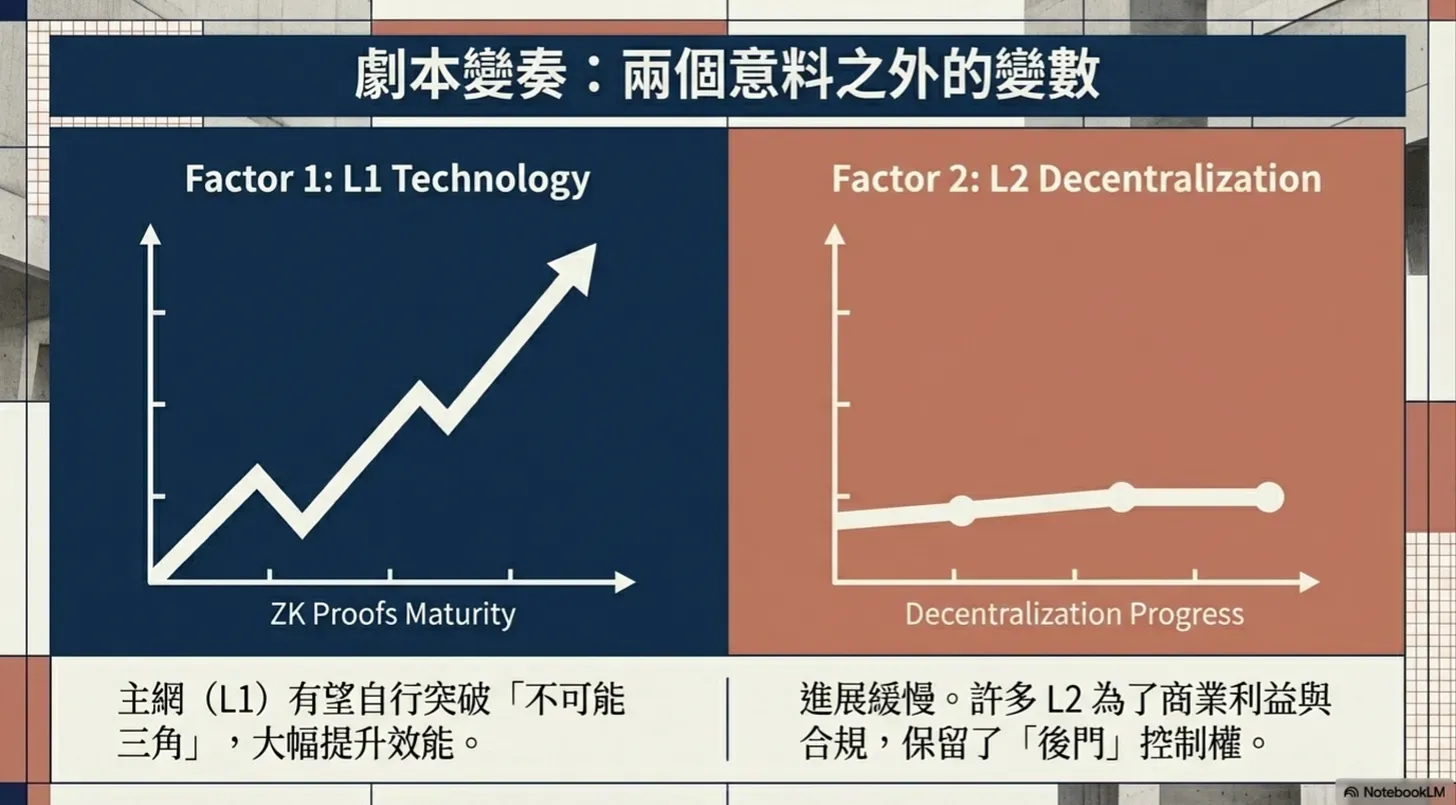
First, L1 scaling has progressed faster than expected.
Second, L2 decentralization has progressed more slowly than anticipated.
Ethereum initially embraced the L2 path as a compromise dictated by the trilemma. If one chain could not simultaneously maximize security, decentralization, and performance, then responsibilities could be separated: let the mainnet safeguard security and decentralization, and outsource efficiency to Layer 2.
However, technological advancements in recent years—particularly the maturation of zero-knowledge proofs—have led Vitalik to believe that Ethereum’s mainnet may soon be capable of breaking through the trilemma on its own.
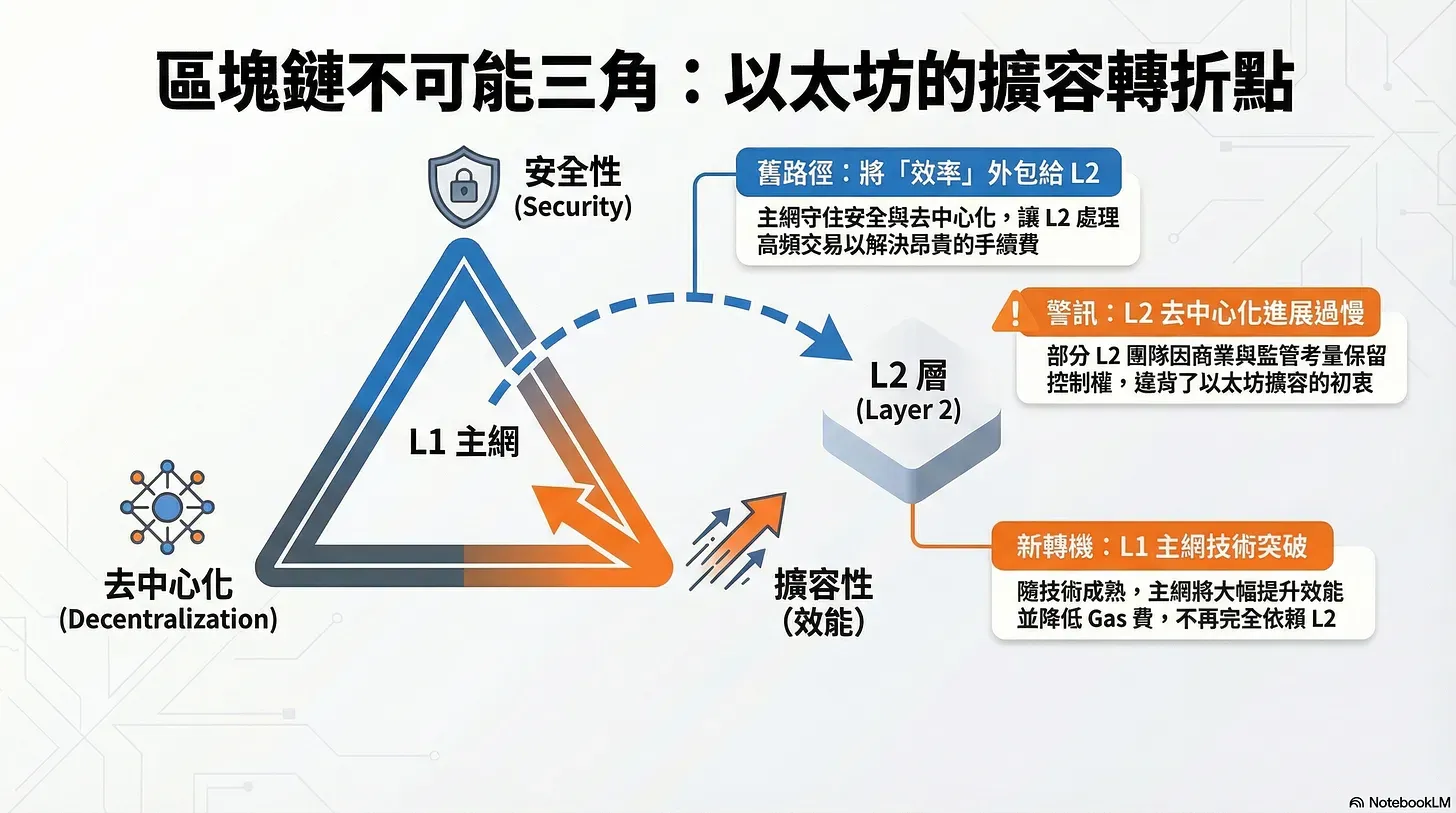
What ultimately prompted Vitalik Buterin to revise the roadmap was his realization that some L2s had been slow to progress toward decentralization due to commercial and political considerations:
I’ve seen L2 teams explicitly state that they will never decentralize. This isn’t just due to technical concerns, but also because of regulatory requirements from customers who want the L2 to retain ultimate control. That may be the right choice for your customers. But if you choose to do that, then you are not scaling Ethereum in the original sense. And that’s okay. Because Ethereum itself is scaling, and over the next few years we plan to significantly increase the gas limit.
Reading between the lines, you can sense Vitalik’s impatience. Ethereum has always placed decentralization above all else, willing to sacrifice efficiency rather than compromise on that principle. Yet some L2s, after successfully attracting users with promises of high efficiency and low fees, began recalculating their incentives. If users and applications are already on their platform, retaining control of the blockchain may better serve commercial interests and regulatory requirements—so why insist on full decentralization?
This clearly crossed Vitalik’s red line. These L2s, in his view, have put the cart before the horse—they are no longer truly “scaling Ethereum.” If that’s the case, they should openly acknowledge that they are building their own L1s rather than operating under Ethereum’s banner. For Ethereum, turning a blind eye would be like “raising rats that end up chewing through your own grain sack.” After five years of effort, the worst outcome would be that Ethereum’s mainnet fails to truly scale, while L2s also fail to decentralize—leaving everyone busy but achieving little.
Recent technical upgrades to Ethereum’s mainnet have also given Vitalik leverage to take this harder stance. If L1 performance is indeed set to improve significantly, then the burden of scaling no longer needs to rest entirely on L2s. Once mainnet gas fees become sufficiently low, users may simply ignore L2 altogether. From a user experience perspective, that would be unequivocally good news.
A Crisis of Trust Among Developers
Over the past few years, during speaking engagements, the question I’ve feared most is: “Why does the ETH you sent me say Base on it? What does that mean?”
To this day, I still can’t explain it clearly in a single sentence. I usually give a vague answer like, “It’s just ETH with cheaper transaction fees.” And internally, I pray they don’t try to transfer that ETH to a centralized exchange—because there’s a high chance they’ll send it via the wrong chain.
In recent years, exchange customer service teams have been flooded with support tickets related to funds sent on the wrong network. Developers have spent enormous effort building cross-chain bridges and implementing account abstraction, all in an attempt to hide the complexity of L2s. Deep down, everyone knows that L2 fragmentation has severely damaged the user experience—that’s why these issues keep surfacing.
Originally, L2 complexity was treated as a necessary evil to bring down gas fees. But if technological progress unfolds as smoothly as Vitalik Buterin anticipates, much of the current UX-focused engineering effort may no longer be as urgent. In the future, perhaps only advanced users will need to deeply understand L2 mechanics, while most people can simply use Ethereum without worrying about the underlying layers.
To be honest, I’m not yet fully convinced by Vitalik’s new narrative. Some commenters under his post have also questioned whether technological progress will be as optimistic as he suggests. But if the mainnet truly delivers low costs and a better user experience, users will vote with their feet—and most L2s may be phased out.
It’s no surprise that L2 teams are upset. Even if this isn’t entirely Vitalik’s fault, it inevitably damages trust. After this episode, developers may think twice before committing significant resources: if the roadmap changes again, will they become the next technological orphan? As a user, though, I’m cautiously optimistic 😆