HuoYing: A Visual News Agency Building “Digital Negatives” with Blockchain


GM,
A quick reminder to readers who haven’t yet filled out the 2025 Content Satisfaction Survey: I hope you can spare 10 minutes to share your feedback and help Blocktrend do better. And a big thank-you as well to the members who have already completed it! Now, let’s get to the main topic.
Recently, Blocktrend has been collaborating with the Taiwanese startup Numbers Protocol to enable AI agents to pay for access to content in the future. Through this collaboration, I also came to know another partner of Numbers — “HuoYing” (伙影社), Taiwan’s first blockchain-based visual storytelling news platform.
Excellence in Journalism Award
HuoYing recently received recognition from the Excellence in Journalism Awards. Its founder, Yu Chih-Wei, is a veteran photojournalist. According to a report by Verse:
At the 2025 Excellence in Journalism Awards ceremony, a media platform that had been established for just over a year received four nominations and ultimately took home the Series News Photography Award and the International News Award.
This visual news agency, called HuoYing, is neither the photography department of a mainstream media outlet nor a long-established wire service. Instead, it is Taiwan’s first independent visual platform built on a blockchain-based infrastructure.
Its founder, Yu Chih-Wei, is a seasoned professional with over 20 years of experience as a photojournalist, having worked at Apple Daily, The Storm Media, and The Reporter. After leaving a stable managerial position, he chose a more challenging path — one that has clearly borne abundant fruit.
This passage reminded me of another repeatedly award-winning Hong Kong writer, Dung Kai-cheung¹. Both had already achieved extraordinary professional success and secured their positions within established systems, yet still chose to step outside their comfort zones, leveraging their existing reputations to pursue bold new experiments. It’s truly admirable.
Before founding HuoYing, Yu Chih-Wei served as Head of Photography at The Reporter, a Taiwanese nonprofit news organization. At the time, Numbers approached The Reporter to discuss using blockchain technology for content preservation and licensing. Before the project was fully implemented, Yu left the organization — a move that later became the catalyst for the collaboration between HuoYing and Numbers.
When you open the HuoYing website, you can initially think of it as a commercial stock image platform. Its content is divided into two main sections: an image archive and licensed photojournalism and visual reports.
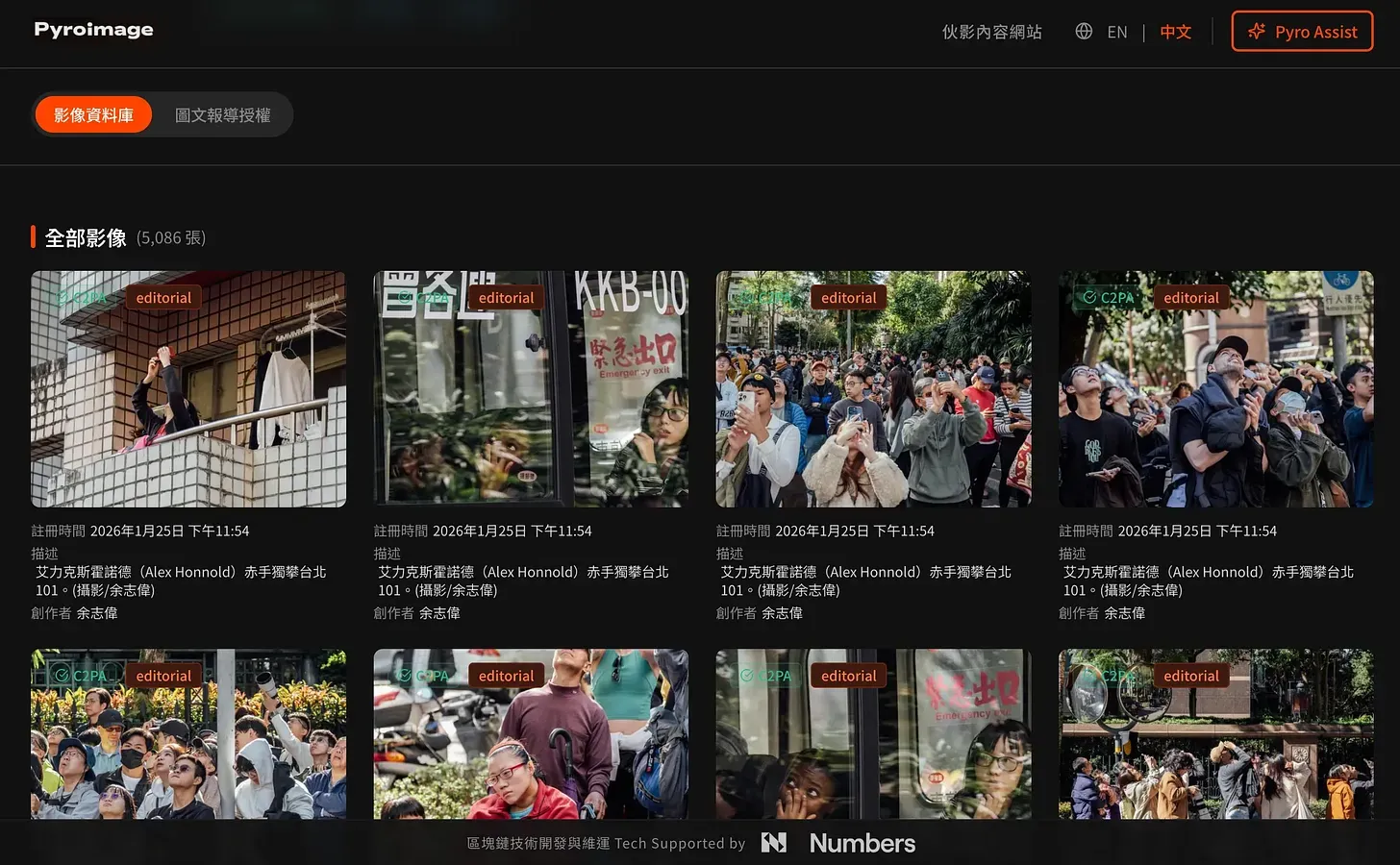
The most recent work is the visual documentation captured by Yu Chih-Wei on site when Alex Honnold visited Taiwan and free-solo climbed Taipei 101. After clicking on a photo, you can view its source information and obtain a commercial license based on your intended use.
I recommend choosing the Creative Commons (CC) option to obtain the photos and a license certificate for free, so you can experience the entire process firsthand. After completing the acquisition, you’ll receive the original image file along with a PDF-format commercial license certificate. You can then use the photo for its designated purposes—such as writing an article, editing a video, or creating a presentation.
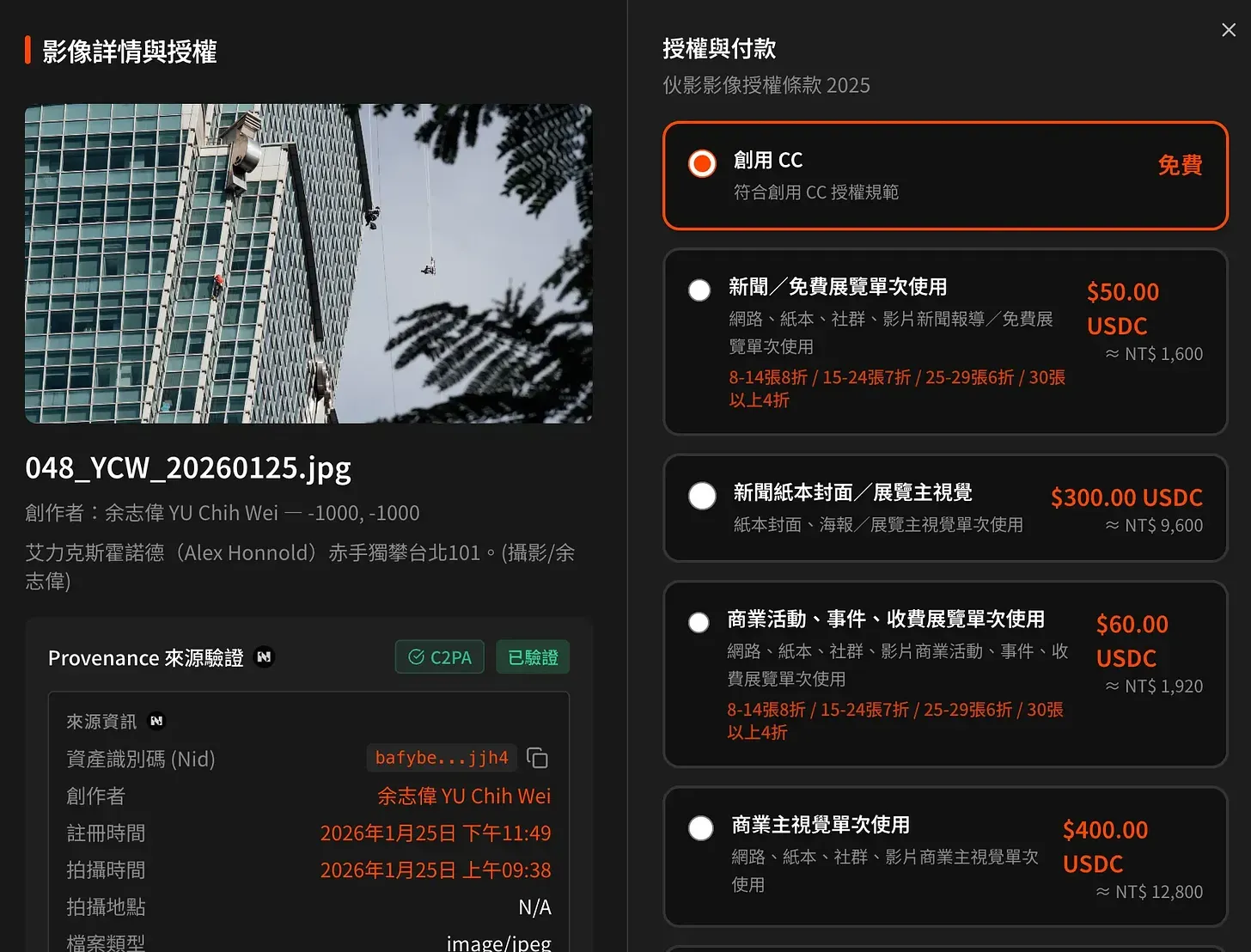
From browsing to purchase, users never have to interact with blockchain technology at all. Even without a wallet, the process can be completed smoothly. This naturally raises a question: where exactly does HuoYing use blockchain?
Digital Negatives
To answer this, we need to start with the licensing mechanisms of digital content.
Take YouTube, a platform everyone is familiar with, as an example. If creators want to add background music to their videos, they must legally obtain the appropriate license. Otherwise, when YouTube detects potential copyright infringement and the creator cannot provide proof of authorization, the video will be unable to generate revenue and may even be forcibly taken down.
Visual content creation follows a similar logic. Traditionally, photographers upload their photos to commercial stock libraries such as Getty Images or Shutterstock, effectively authorizing these platforms to sell the images, manage licenses, and help detect infringements. If a dispute arises, photographers must produce physical proof—the film negative—to demonstrate that the work is their own.
However, today more and more photographers shoot with smartphones and share their work on social media. Without physical negatives, how can we determine who the original creator truly is?
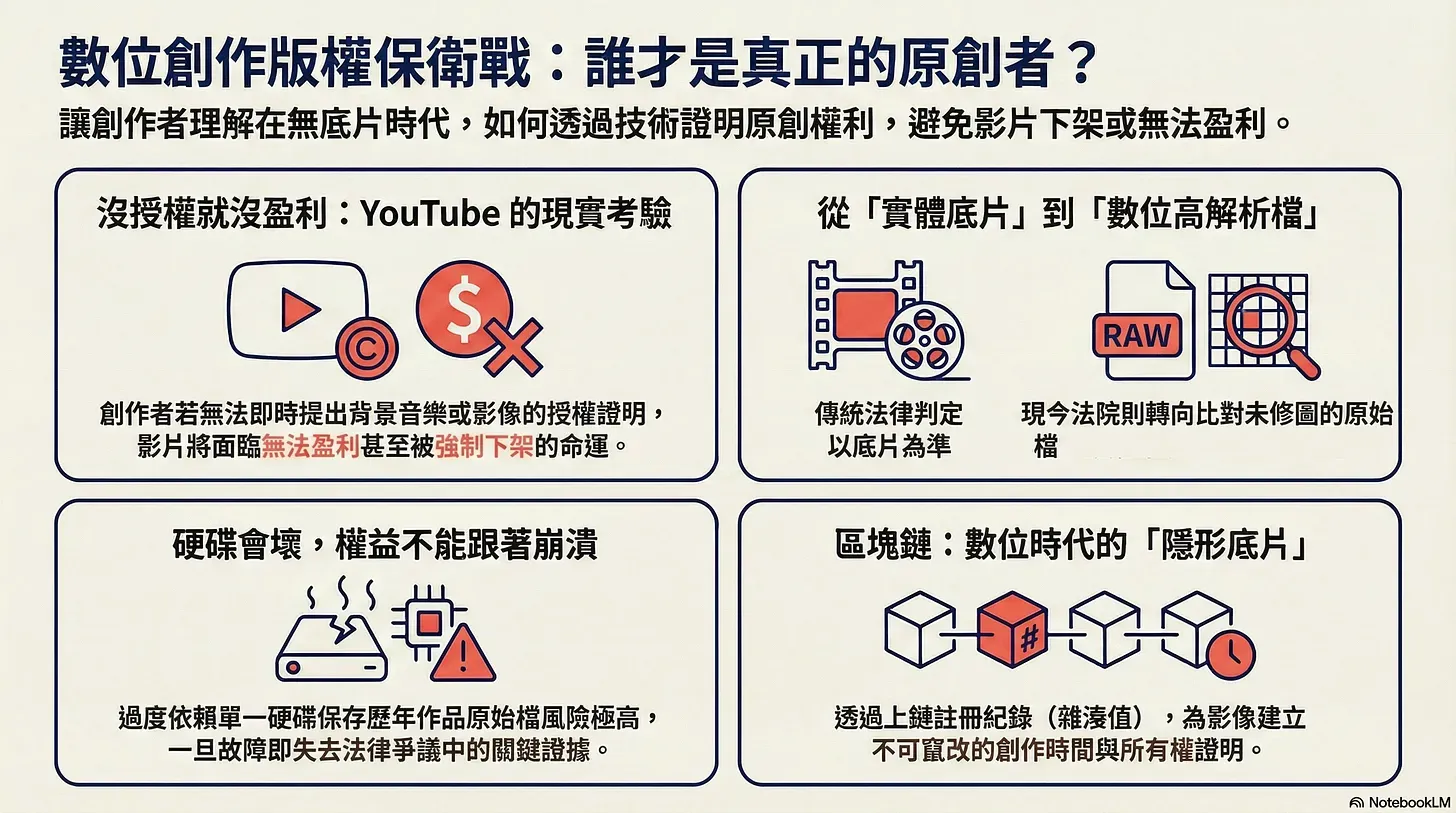
In practice, courts determine authorship based on who can produce the original files—such as unedited, high-resolution images. This means photographers must not only store vast archives of their work over the years, but also hope that their hard drives never fail. Otherwise, if a dispute arises and the original files cannot be produced, they may find themselves at a serious disadvantage.
The greatest innovation of HuoYing lies in treating blockchain as the “film negative” of a digital camera. Most of the time, neither party needs to worry about where the “negative” is when purchasing a license, nor do they need to understand the technical details behind it. But if a dispute does occur, photographers can present on-chain registration records—such as hash values—to prove the creation time of an image and assert their rights.
This is quite similar to the problem that the Taiwan Judicial Alliance Chain² aims to address. When prosecutors and investigators seize digital evidence, the data is immediately converted into hash values and recorded on-chain. In most cases, these on-chain records are simply there as a precaution. But when parties dispute in court whether digital evidence has been tampered with, judges can, in addition to summoning relevant witnesses, refer to blockchain records to compare differences and use them as a basis for judgment.
Both examples seek to establish institutional safeguards through blockchain. Still, if I were a photographer, I probably wouldn’t place all my hopes on blockchain in the short term. After all, there are not many precedents, and whether courts are willing to accept on-chain evidence remains an open question.
Precisely because blockchain remains highly uncertain in practical legal recognition, it becomes even more intriguing to ask what motivated Yu Chih-Wei to found HuoYing. As it turns out, he hoped to use new technology to rewrite the production relations of the photography industry. This aligns closely with Gao Chong-jian’s view: “AI is meant to improve production efficiency, while blockchain focuses more on improving production relations.”
Rewriting Production Relations
Where does a photographer’s income come from? Joining a media organization, selling work to commercial stock libraries, or operating independently and taking on freelance commissions. But as early as around 80 years ago, a group of photojournalists decided to break away from major media outlets and jointly establish Magnum Photos.
Magnum Photos is often regarded as the temple of documentary photography. Before Magnum was founded, photographers were mostly employed by large magazines, with copyrights owned by the media organizations, and editors free to crop or rearrange images at will. Magnum became the first cooperative in history to be collectively run by photographers. They insisted that photographers retain ownership of their negatives and copyrights, and that editors could not alter photos without permission. This fundamentally shifted photographers’ position in the industry—from technical employees to independent creators.
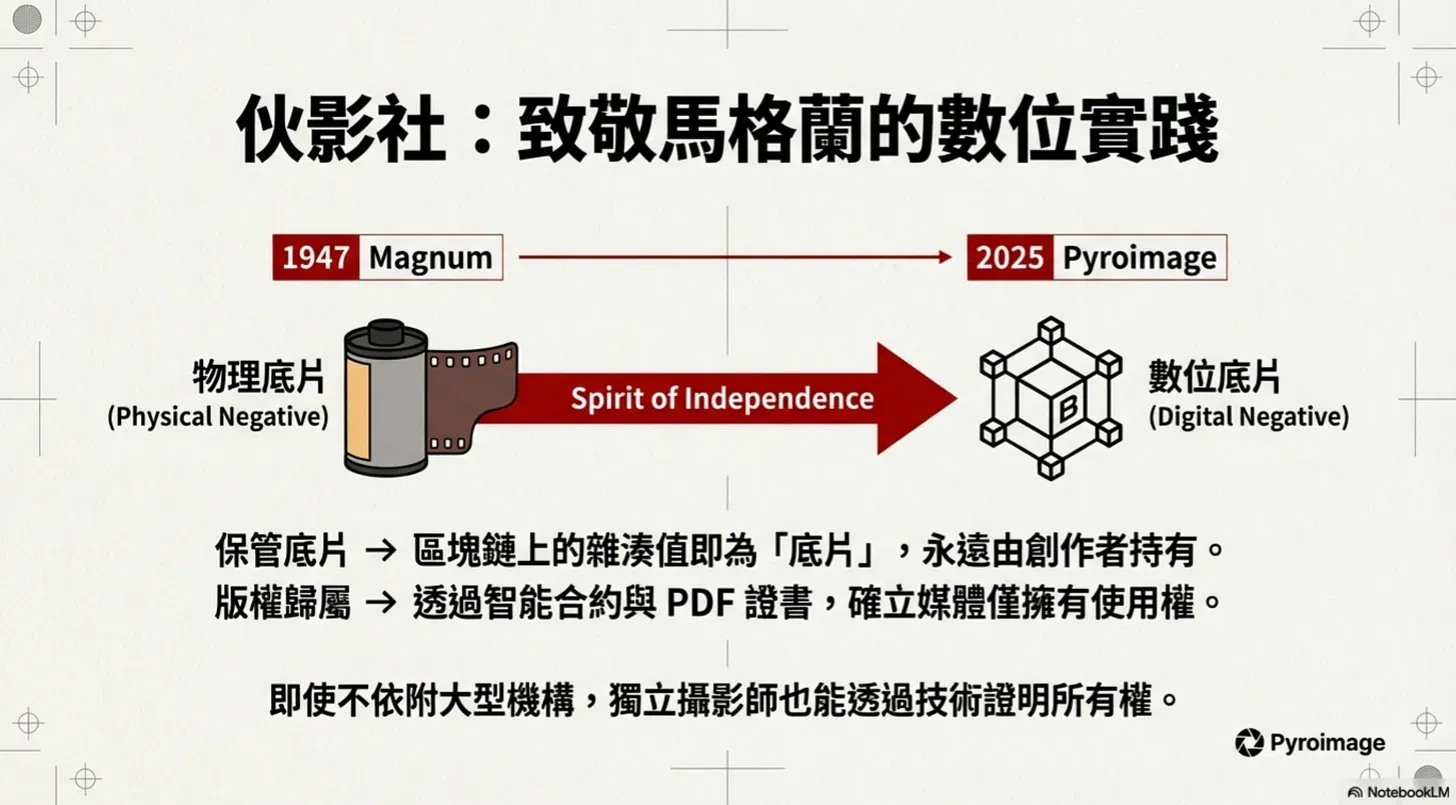
Magnum’s official website also documents this history. In 1947, just after the end of World War II, four war photographers reflected on the fact that they had risked their lives on the front lines, capturing countless invaluable images, yet had no control over how their works were later used. They therefore decided to form a photographers’ cooperative and laid down two ironclad rules:
- Negatives are kept by the photographers themselves
- Copyright belongs to the photographers; media outlets may only purchase usage rights
HuoYing openly pays tribute to the Magnum spirit on its website and uses blockchain technology to put these principles into practice. After photographers upload their works to HuoYing, they receive a PDF document representing copyright ownership, which is also recorded on the blockchain. As long as the blockchain continues to operate, a photographer’s “digital negatives” gain an additional layer of protection.
In the past, buyers tended to purchase photos from large stock libraries because the risk was lower and the likelihood of buying pirated works was smaller. By contrast, independent photographers often found it harder to earn buyers’ trust. Blockchain provides an additional tool for proving ownership, enabling photographers to license and operate independently—even without relying on media organizations or stock libraries.
At first, I couldn’t understand why people like Yu Chih-Wei and Dung Kai-cheung, who had already achieved significant success in their respective fields, didn’t choose to remain safely within established institutions. But perhaps it is precisely because they have attained what most people could never hope to achieve in a lifetime that they have the freedom, when new technologies emerge, to ask the next-level question: is there an even better possibility for existing content production relations?
2 The Judicial Alliance Chain: A National-Level Digital Seal and the Possibility of Collapse