【Event Preview】 The Failed "Ming-En Coin" and the 2026 Red Envelope Year One: My Seven-Year Experiment


GM,
This is the final article before the Lunar New Year break, and I’d like to start by wishing everyone a Happy New Year.
As a heads-up, I have prepared "Stablecoin Red Envelopes" for our members this year—and don't worry, there won't be any disappointing "empty" envelopes. If you receive an email from Blocktrend during the holiday period, that’s the red envelope knocking on your door. Be sure to open it promptly!
That said, why did Blocktrend suddenly decide to send out red envelopes this year? The story begins seven years ago.
Ming-En Coin
The Lunar New Year of 2019 was the most uncertain bear market I have ever experienced.
At the time, Blocktrend had been established for less than two years, and crypto prices had plummeted from their all-time highs to rock bottom. BTC was sitting at just $3,000, and ETH had dropped below $100. During that period, the most popular application on-chain was issuing entirely new tokens on Ethereum and writing a whitepaper to give those tokens "utility."
I had a sudden inspiration. Since the ETH I held had already crashed in value, why not use it to issue some "Ming-En Coins" as Lunar New Year red envelopes for my parents? Back in 2018, I shared a token-issuance website called Token Factory 1. By simply filling in the total supply, token name, decimal places, and symbol—and paying about NT$40 in gas fees—one could obtain a set of customized cryptocurrency.
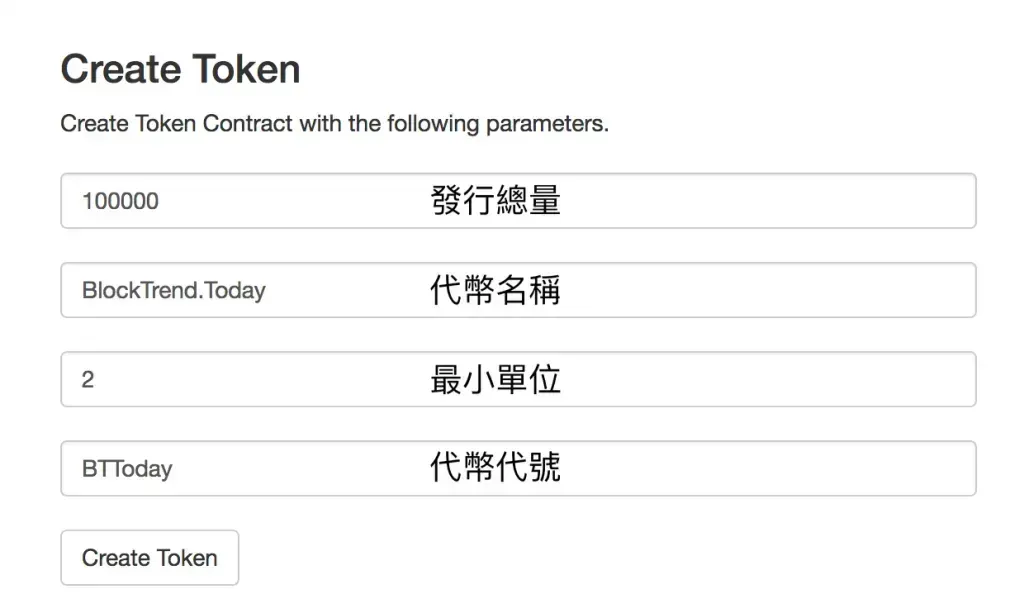
Consequently, I issued a total of 7,200 "Ming-En Coins" and sent them in two transactions—3,600 coins each—to my parents as Lunar New Year red envelopes. Thanks to their good nature, they didn't hold it against me and even played along, seriously installing wallets on their phones with me.
Afterward, their only question was: what are these "Ming-En Coins" actually for? Obviously, they couldn't be exchanged for cash, so I had to make up some "use cases" like washing the dishes or taking out the trash. To put it bluntly, Ming-En Coins were essentially "debt" I issued upfront, to be repaid slowly through my labor. But seven years later, those coins are still sitting quietly in my parents' wallets because I completely forgot to transfer ETH to them for gas fees—so they couldn't spend them even if they wanted to 😂.
Looking back, it was a total farce. Yet, that experience became the perfect memory anchor to contrast with the concrete progress of blockchain over the past seven years. This time, the red envelopes I’ve prepared for everyone are not just stablecoins equivalent to cash; they don't require me to manually transfer them one by one, and even the gas fees can be waived. The only condition is that you must use a Fluidkey wallet to claim them.
This is, of course, a marketing campaign aimed at letting users personally experience the value of "privacy."
Privacy Wallets
Since the rise of mobile payments, more and more people send red envelopes via social media or instant messaging apps, creating a new culture of "grabbing red envelopes." While red envelope events hosted by major exchanges have been around for years, almost no one sends them directly on-chain. Why?
My guess is they’re afraid no one will claim them 😂.
The internal red envelope mechanisms of exchanges are already very mature, with no infrastructure issues. Money flows within the platform, so there’s no need to worry about gas fees, wallet exposure, or tracking fund movements. As long as both parties have an exchange account, the experience is similar to a messaging app.
However, if you want to use cryptocurrency to send red envelopes on-chain, things get much more complicated.
The mere fact that "you have to provide your own gas fees just to grab a red envelope" is enough to kill the mood. Not to mention having to consider which chain to use, whether the recipient has a wallet, or if they even know how to operate it. Even if none of those are issues, every transaction record is public. Exposing your entire financial history just to claim a few dollars in a red envelope is frankly embarrassing. After navigating these hurdles, most of the red envelopes would likely go unclaimed—just imagining the scene is a bit pathetic.
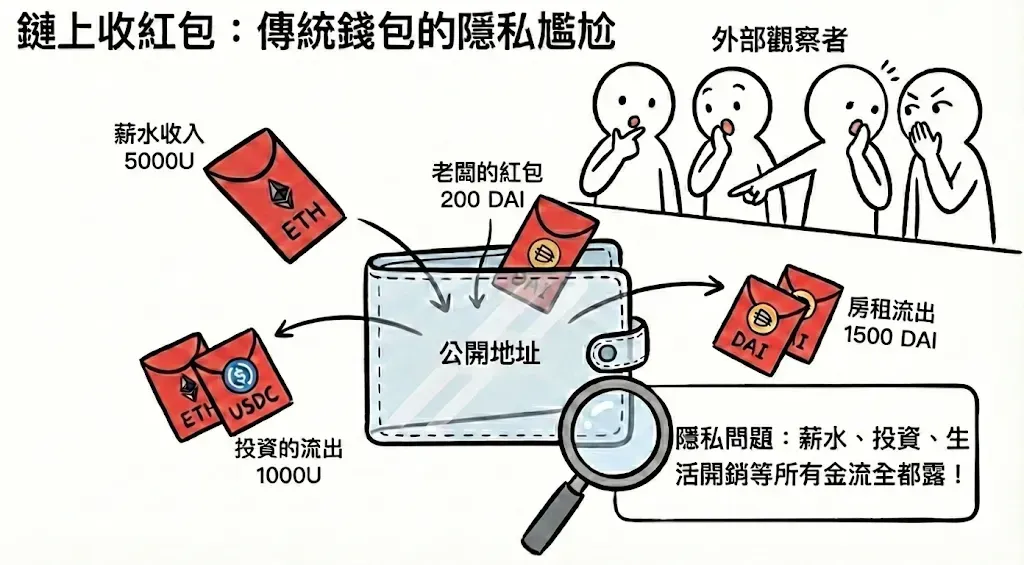
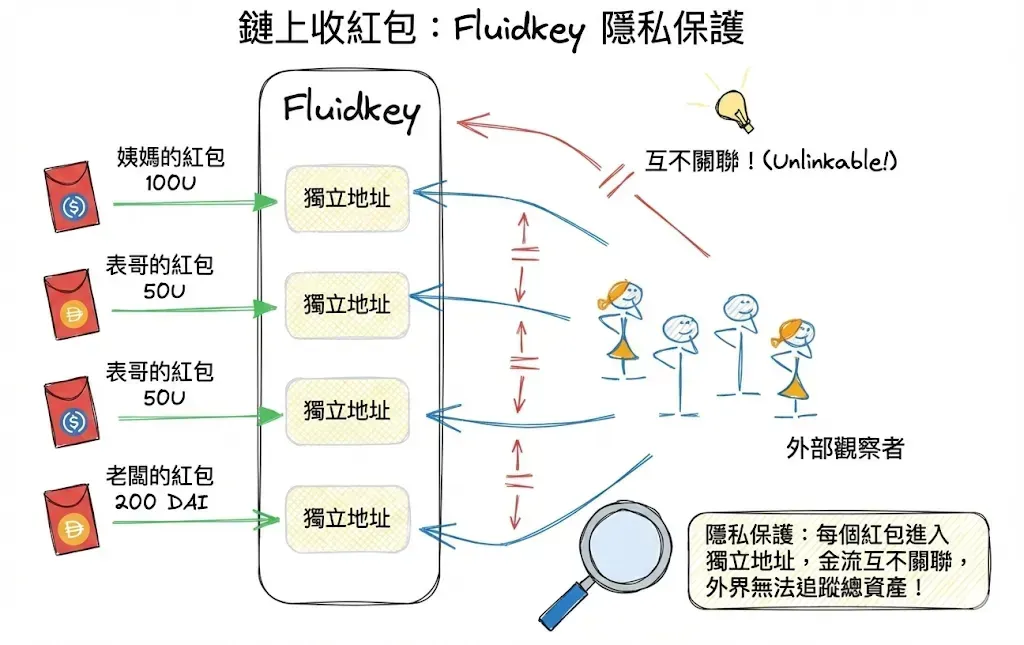
The good news is that 2026 can be called the "Year One of Red Envelopes." Stablecoins have made sending red envelopes as straightforward as giving cash; gas fees can be subsidized by wallets, and creating a wallet is as simple as entering an email address. Even the most troublesome issue—financial privacy—can now be handled via Fluidkey’s stealth addresses.
A stealth address is like placing each sum of money into a different pocket, each kept independently; only the user knows the total balance of all these pockets combined. The biggest difference between this and a crypto mixer is that the funds are not mingled with other people's transactions, thereby eliminating money laundering concerns. Every time a user claims a red envelope, Fluidkey automatically generates a new "pocket" to store it separately, balancing both privacy and compliance.
From a traditional product development perspective, it has taken the crypto world seven years just to piece together a viable red envelope application—which sounds almost laughable. However, this viewpoint overlooks the most critical element of on-chain applications: composability.
Fluidkey’s red envelope product is more like "building with Legos." The underlying layer uses Base, the stablecoin is USDC, and the wallet is provided by Privy; only the stealth addresses were built by Fluidkey themselves. Each of these building blocks developed independently until they finally matured enough to be assembled into an entirely new application.
This is similar to the historical combination of GPS, 4G networks, and smartphones. GPS was originally for navigation, 4G was for internet access, and phones were for communication. It wasn't until these technologies matured simultaneously that people suddenly realized: assembling them could create a brand-new service like Uber. That same combination also gave birth to completely different applications like Google Maps and speed camera alerts. Sending red envelopes is simply one of the many application scenarios that these "Legos" can build.
Sending Red Envelopes for the New Year
Blocktrend is writing about this topic not to run an advertisement for Fluidkey. In fact, "sending red envelopes for the New Year" was an idea I proposed. To my surprise, the Fluidkey team was immediately on board. They didn't just take charge of the engineering development; they even proactively sponsored the red envelope funds to encourage everyone to experience it firsthand.
As someone who only contributed the idea while becoming the biggest beneficiary, I certainly couldn't just sit back. Inviting everyone to claim these red envelopes is Blocktrend’s greatest contribution as a partner. If you receive an email from Blocktrend during the Lunar New Year break, it’s very likely your red envelope has arrived. The simpler the process, the fiercer the competition—so remember to act fast.
Wishing everyone a Happy New Year and a wallet full of red envelopes! 🧧