Building My Own Ethereum Upgrade Map! My AI-Powered Open-Source Co-Creation Experiment

GM,
Lately, I’ve been so immersed in AI that I’ve practically forgotten to eat and sleep. I have to assign AI some tasks before I’m willing to step away for meals, showers, or rest. I’ll also include my AI tool referral codes (Gemini, Replit, Cursor) for those interested.
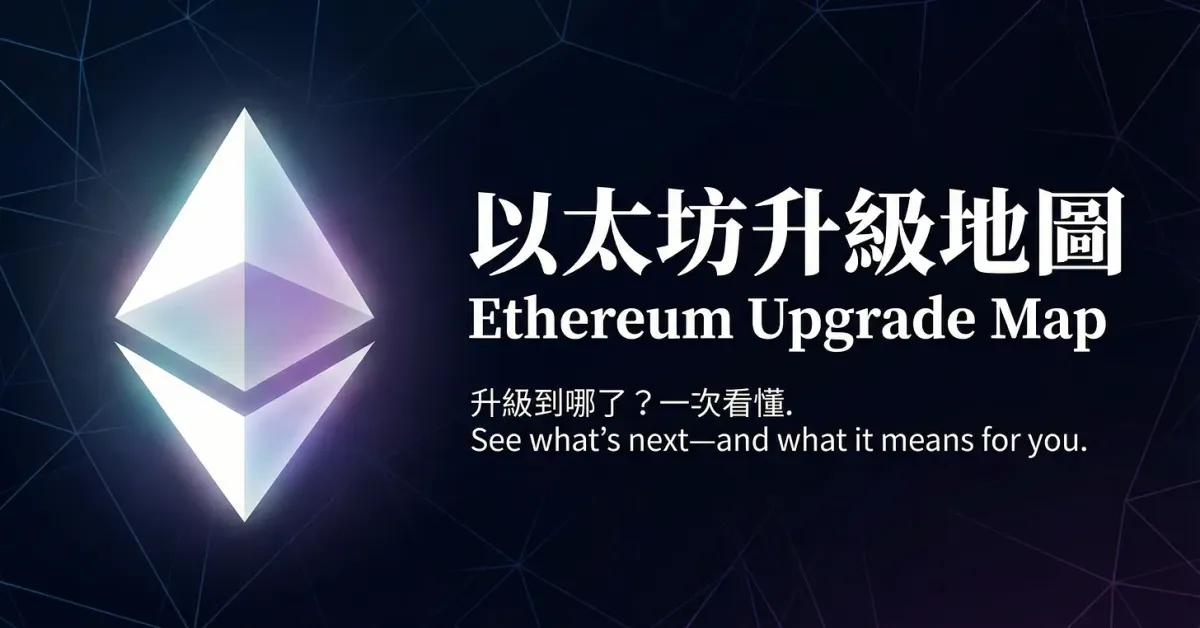
In this article, I want to share a small outcome from my recent experiments with vibe coding: an Ethereum Upgrade Map.
A Strawman Roadmap
Blockchains are like the operating systems of our phones and computers—they undergo upgrades from time to time, introducing new features along the way. Blocktrend has previously covered the concrete impact of Ethereum upgrades on users, including the 2022 Merge that transitioned from PoW to PoS, the 2024 Dencun upgrade that significantly reduced L2 transaction fees, and the late-2025 Fusaka upgrade, which will allow smartphones to function as hardware wallets.
Last week, the Ethereum Foundation released a “strawman roadmap,” outlining the technical upgrades planned through 2030. It’s called a strawman because the document is meant to spark discussion—the final version will only take shape after extensive community debate and consensus-building.
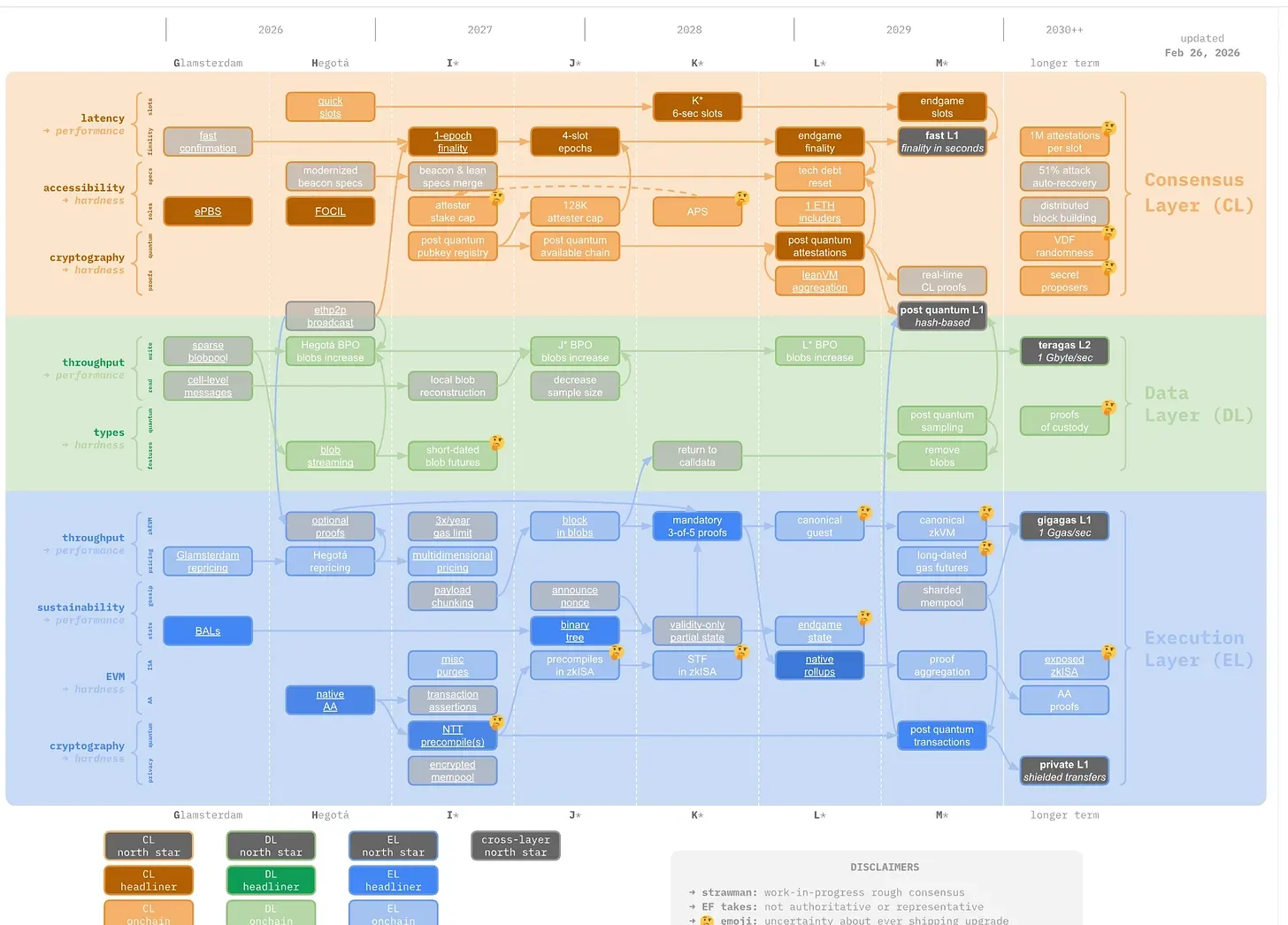
In the past, I would usually skip documents like these altogether. I already knew they would be too dense and technical to digest. The website even clearly states:“This is a high-density technical document written for advanced readers, primarily intended for researchers, developers, and those involved in Ethereum governance.” If you can’t understand it, that’s perfectly reasonable.
That changed in 2025, when the Protocol Support team at the Ethereum Foundation, which coordinates technical development, launched a website called Forkcast. Its goal is to reorganize abstract technical roadmaps and translate them into a more intuitive upgrade progress tracker. According to their introduction to Forkcast:
Ethereum doesn’t have a CEO who can simply press an “update” button. Every system upgrade must reach consensus across 11 independent client teams, researchers, and community participants before it can be implemented. Behind the scenes, this requires dozens of technical meetings, hundreds of GitHub discussion threads, and months of testing and coordination. Forkcast is a visualization tool built on top of this process. It organizes which EIPs are currently on the table, which have client support, and what stage each upgrade has reached—so you can grasp the overall progress without attending every meeting.
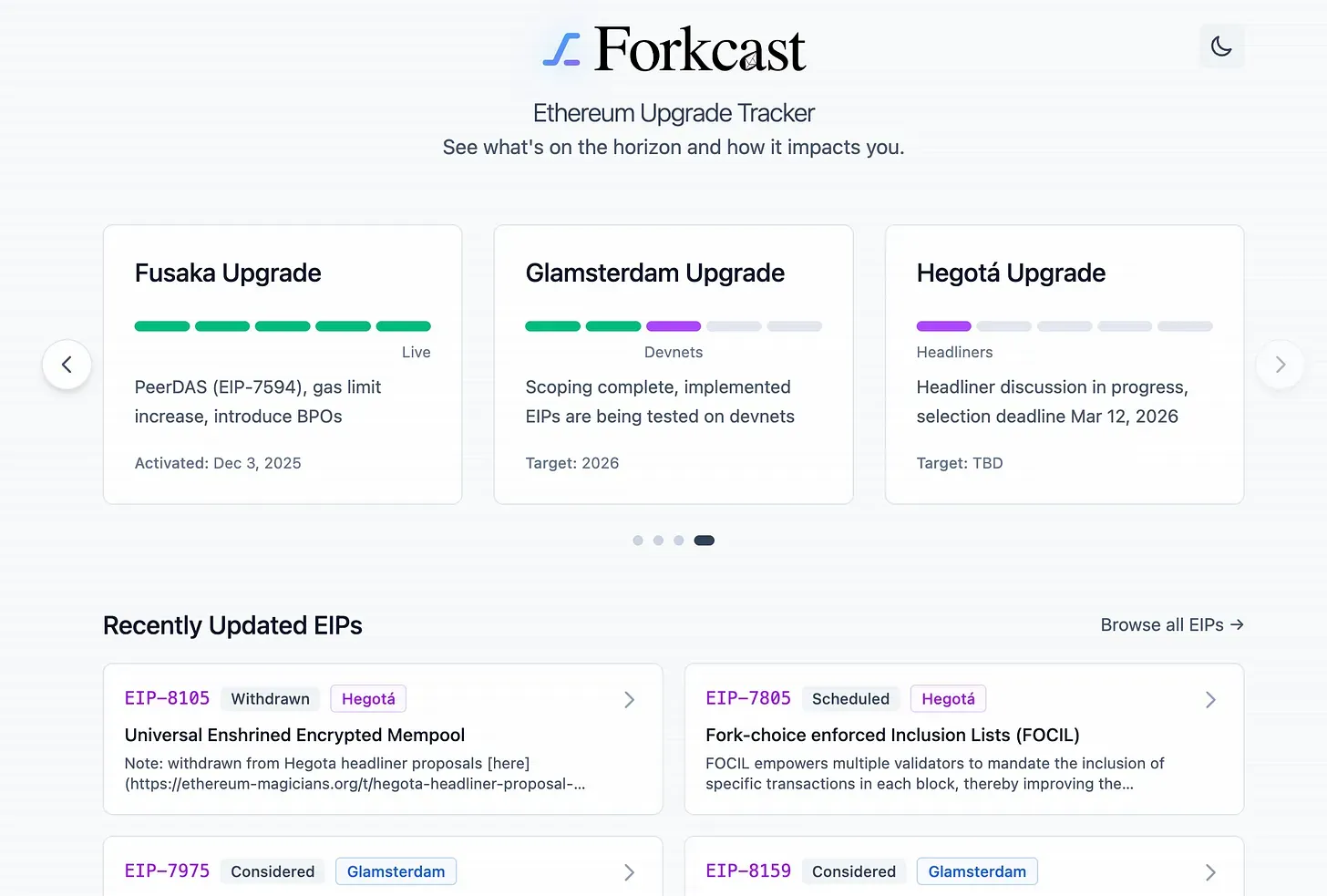
The website’s visual design is quite modern. However, Forkcast ultimately serves technical developers, so for general readers, the barrier to entry is still relatively high. The “Ethereum Upgrade Map” I created is built on top of Forkcast, but redesigned with more accessible content and presented primarily in Traditional Chinese.
Ethereum Upgrade Map
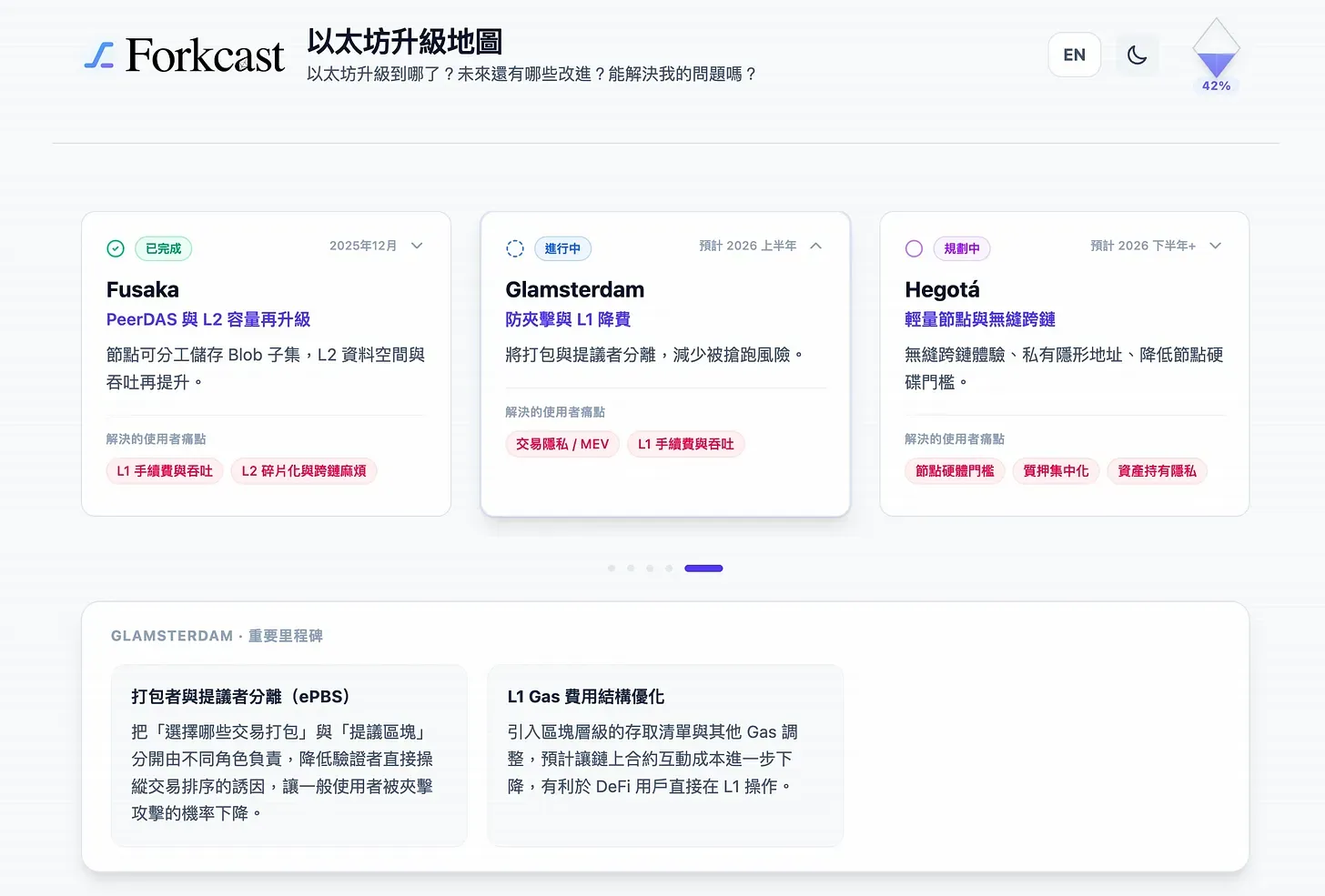
How far along is Ethereum’s upgrade process? What improvements are coming next? Will they solve my problems? If you’ve ever had these questions, this website was designed for you.
The three blocks in the center of the screen represent the three most recent upgrades: Fusaka, Glamsterdam, and Hegota. Each block includes a brief description along with the specific user pain points it aims to address. For example, the Glamsterdam upgrade—scheduled for completion in the first half of 2026—not only aims to reduce L1 gas fees, but also to enhance transaction privacy and lower the risk of on-chain transactions being “sandwiched” by bots.
Swipe the blocks backward, and you can trace Ethereum’s history all the way to its very first upgrade in July 2015: Frontier. It turns out that in its early days, Ethereum even included a “disclaimer,” describing itself as an experimental system and warning developers to be especially mindful of risks. This disclaimer wasn’t removed until after the second system upgrade in 2016.
The “42%” displayed beneath the Ethereum logo in the top-right corner is an additional feature I designed. It represents the overall completion progress of Ethereum’s upgrade roadmap. Click on it, and you’ll see the six major upgrade pillars proposed by Vitalik Buterin several years ago, along with their latest progress updates. The 42% is only a rough estimate—and it may even move backward if the technical roadmap is revised.
What I want users to immediately understand is this: Ethereum is far from finished. In fact, the entire system isn’t even halfway complete. That’s why crypto natives often feel like they’re living on a “construction site.” The industry still experiences frequent “workplace accidents,” and users have plenty of complaints about the system.
These issues will gradually be resolved over time—you just arrived early. At the moment, the “Ethereum Upgrade Map” website is still quite minimal in functionality. I plan to continue updating it and hope to turn it into a public good for the blockchain world. However, I don’t intend to maintain it alone. Instead, I want to adopt an open-source, co-creation model—welcoming others to fork the codebase and adapt it with different designs to meet a wide range of needs.
The Intersection of AI and Blockchain
Where exactly do AI and blockchain intersect?
The most mainstream narrative today is that AI will eventually use cryptocurrency for payments. While I strongly agree with this vision, for now it remains an ideal suspended in midair. For ordinary users, there’s nothing to do but passively wait—we have no real way to participate.
But after this development experience, I’ve come to believe that using AI to build new tools is a far more proactive approach. As a content creator, my first instinct was to create my own “Upgrade Map”—turning a topic I would normally skip into an engaging and tangible project.
In the blockchain world, people often say, “Don’t trust, verify.” But in the past, most people couldn’t read code or dense English technical documents. They had no choice but to rely on others’ interpretations. Now, with AI, users finally have the ability to verify things for themselves. Otherwise, when Vitalik says, “Ethereum L1 performance will significantly improve this year,” how would we know whether that means a 30% increase—or a 300% leap?